
Introduction
If you've ever searched Google and noticed results labeled "Sponsored," there's a good chance you were looking at Google Ads.
Google Ads is one of the best-known online advertising platforms, letting companies put their products and services in front of potential customers at the exact moment those customers are searching for them or showing interest.
Unlike traditional advertising, where you pay to have your message seen by as many people as possible, Google Ads lets you direct your budget more precisely toward users who are already showing intent or interest.
In this guide, we cover the fundamentals of Google Ads — from your first ad to measuring results.
What is Google Ads?
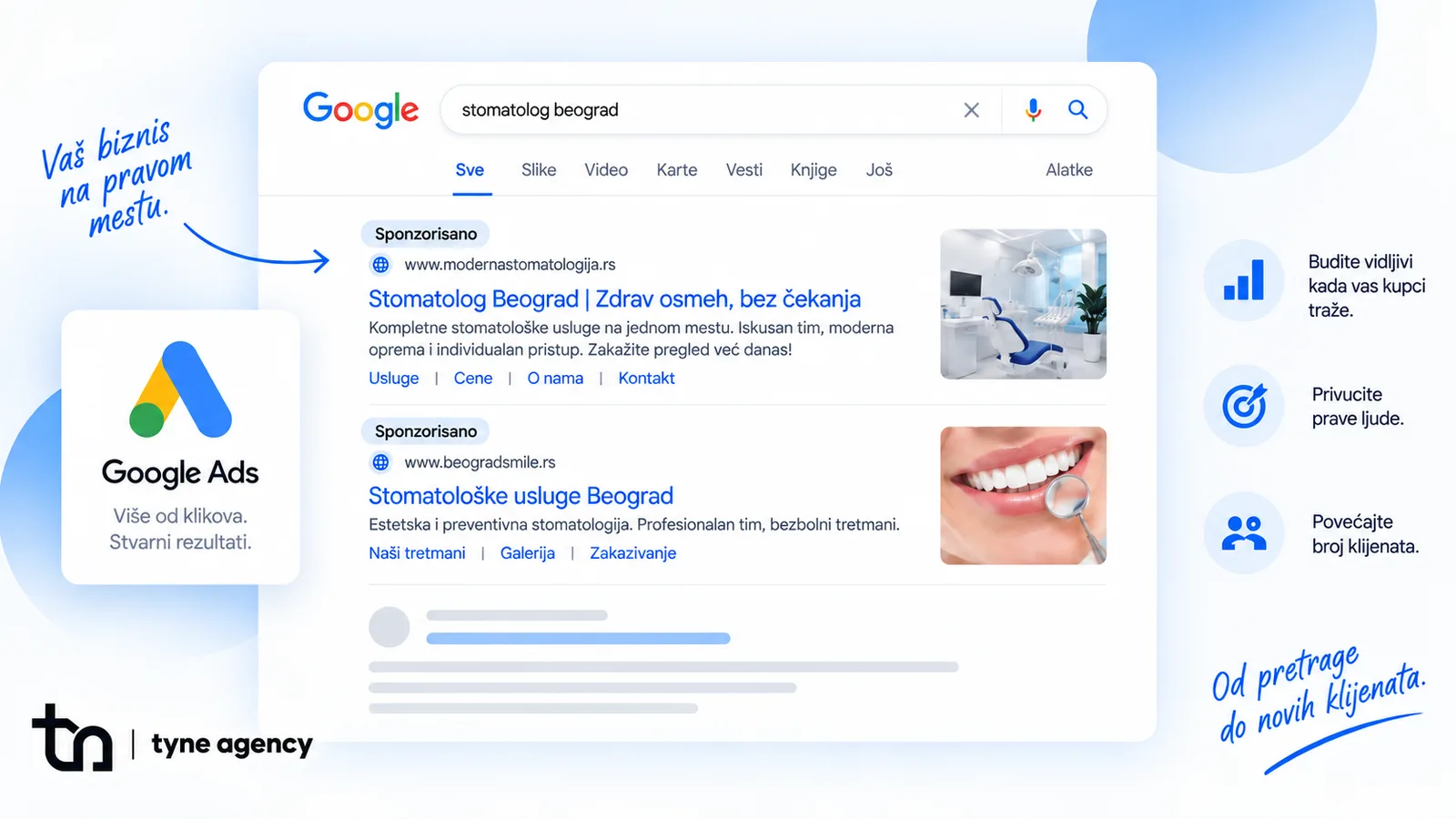
Google Ads is Google's advertising platform, allowing companies to pay to promote products and services to users on Google Search and across other Google channels.
The most familiar example is Search ads. If someone searches "plumber near me," a plumbing company can appear among the paid results.
Similarly, an online store can appear when a shopper searches for a specific product, model, or category.
The main advantage of this approach is user intent: the person is already looking for something, and the advertiser tries to show up at exactly that moment.
How does Google Ads work?
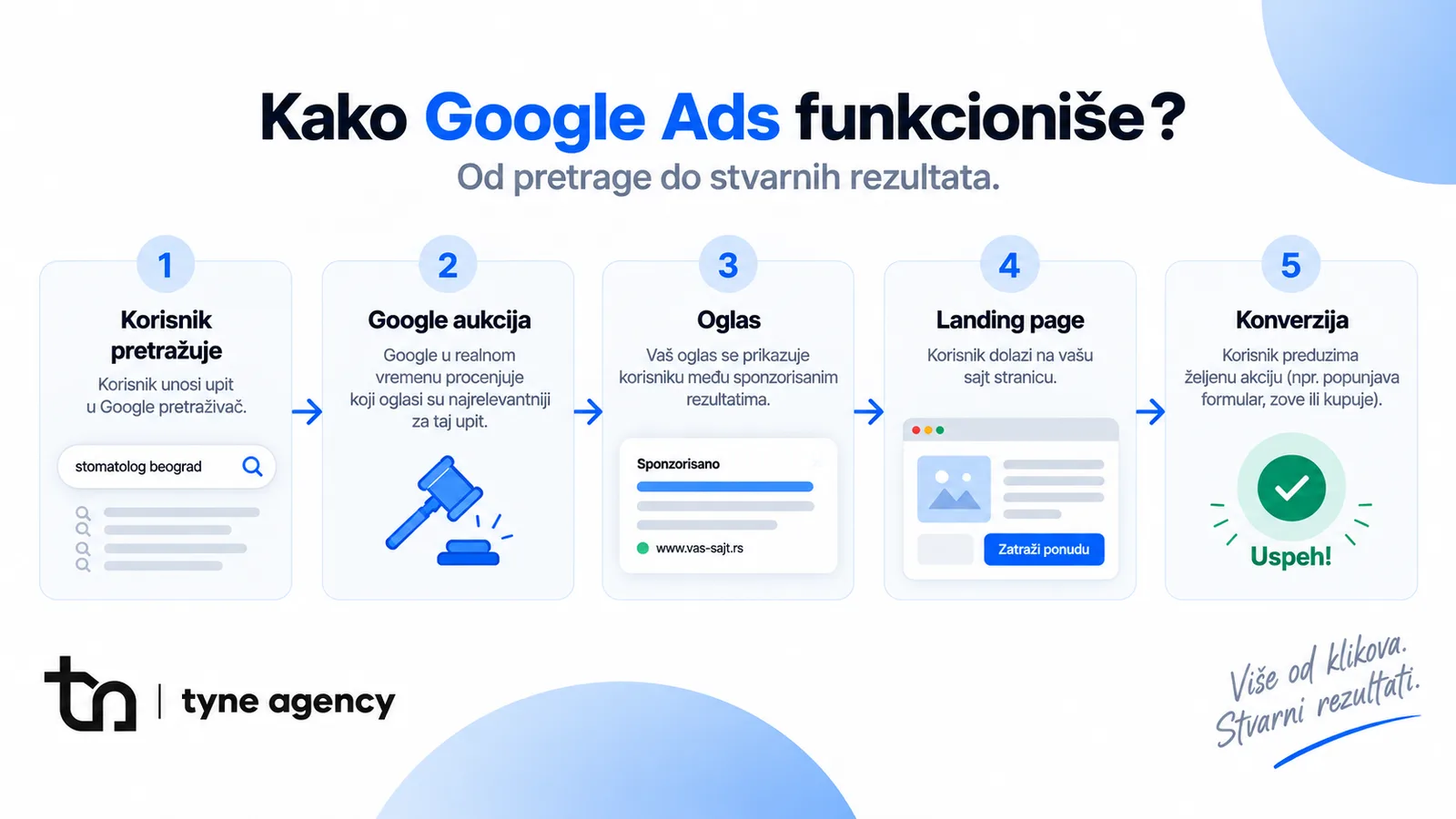
The advertiser defines a campaign goal, selects products or services, defines relevant keywords and/or other signals, creates ads, sets a budget, sets up conversion measurement, and monitors results.
When a user runs a relevant search, Google evaluates which ads can be shown and in what order.
That's why simply paying more doesn't guarantee the top spot. Results are influenced by ad relevance, landing page experience quality, competition, and other factors in Google's ad auction system.
What are keywords?
For Search campaigns, keywords are one of the core elements of the strategy.
If you run an agency offering Google Ads services, relevant searches might include "google ads agency," "google ads management," and "google ads pricing."
If you run a plumbing company, relevant searches might include "plumber London," "emergency plumber," and "plumber near me."
The goal isn't to show your ad for as many searches as possible. The goal is to show it for relevant searches that have the potential to bring in the right customer.
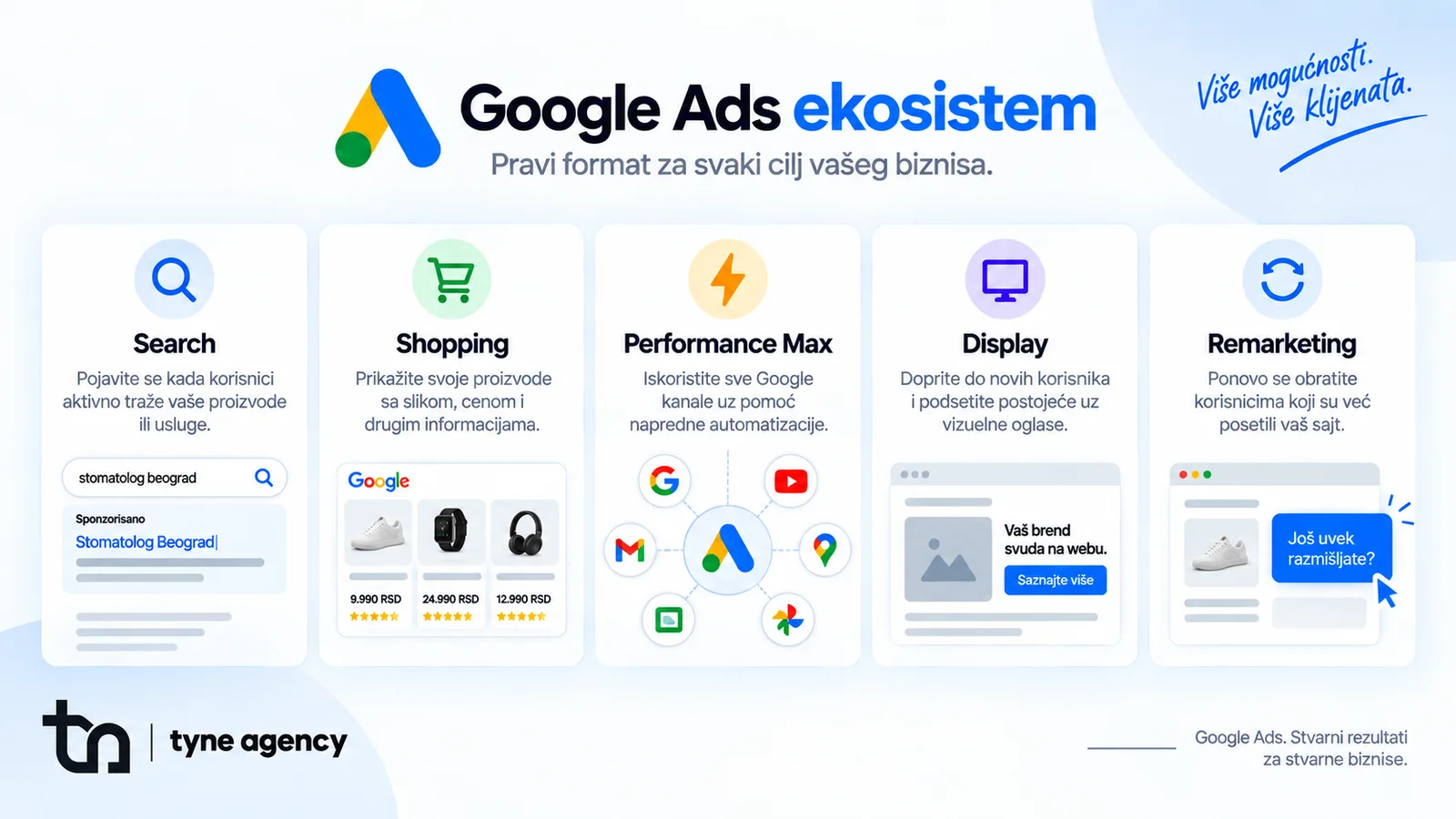
Search campaigns: when a user is actively looking for your product or service
Google Search Ads are text ads that can appear on the Google search results page.
They're especially effective when there's clear demand for a product or service. For example, someone searching "dentist near me" already has a specific need. The same applies to "buy Kärcher vacuum" or "airport transfer."
In these situations, Google Ads lets a company be present at the exact moment a potential customer is actively looking for a solution.
Google Shopping and e-commerce
Shopping ads display products along with information such as product name, price, image, store, and other relevant details.
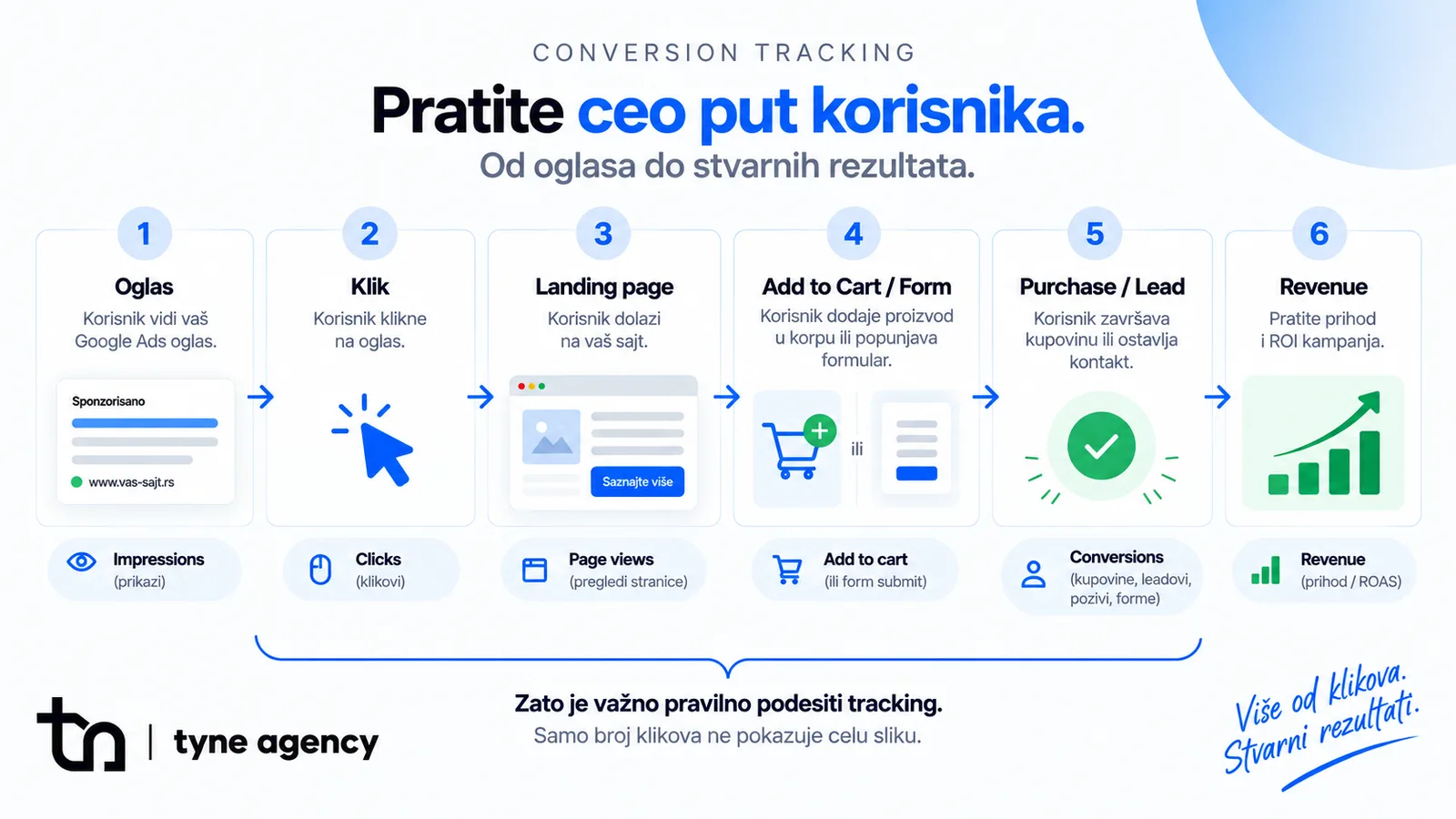
For an online store, the goal isn't just getting a user to visit the site. It's important to track what happens after the click: Product view → Add to cart → Checkout → Purchase.
That data makes it possible to assess which products, campaigns, and segments actually deliver results.
Performance Max campaigns
Performance Max campaigns use Google's automated systems to show ads across different Google channels, depending on the campaign goal and available data.
The system tries to find users with the highest likelihood of completing the desired conversion. This can be especially interesting for e-commerce and companies that have enough quality data to optimize against.
However, automation doesn't mean a campaign can just be launched and left unattended. Data quality, conversion tracking, campaign structure, product feed, creative assets, and business goals still matter a great deal.
Display ads
The Google Display Network shows visual ads across a wide range of websites and digital surfaces within Google's advertising ecosystem.
Display can serve different roles, including remarketing, building awareness, promoting an offer, and re-engaging users who've already visited your site.
For example, a user might visit an online store, look at a product, but not complete a purchase. Later, they might see an ad for that same brand while browsing other sites. That's one example of remarketing.
How much does Google Ads cost?
There's no universal price.
Google Ads runs on an auction system, and cost depends on many factors, including competition, industry, keywords, location, ad quality and relevance, campaign goal, market, and demand.
That's why two companies can end up with completely different costs per click even when running the same type of campaign.
It's important to distinguish between your advertising budget and the cost of managing campaigns. For example, a €1,000 monthly Google Ads budget is money spent on the platform and ad delivery itself. The cost of an agency or specialist managing the campaigns is a separate expense.
How much budget should you allocate?
Budget depends on market size, average cost per click, competition, the value of your product or service, margin, your target number of conversions, and expected acquisition cost.
A local business targeting a single city may need a completely different budget than an e-commerce company selling nationwide.
That's why budget should be viewed in the context of your business economics, not just as a fixed monthly number.
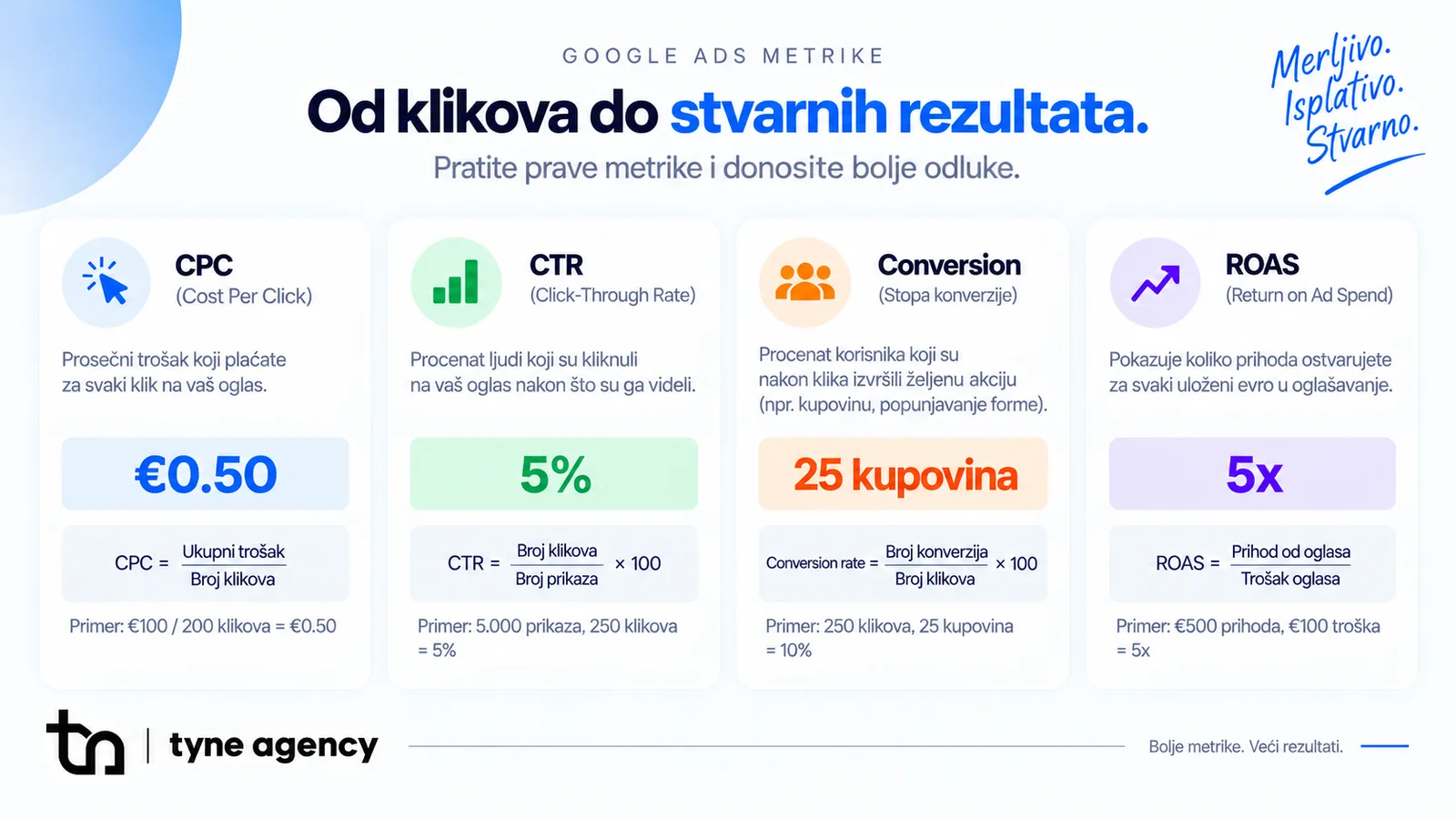
What is CPC?
CPC (Cost Per Click) is the price an advertiser pays for a click on an ad.
If you spend €100 and get 200 clicks, your CPC is €0.50.
But a low CPC on its own doesn't mean a campaign is successful. You can have very cheap clicks that never turn into a single sale. That's why CPC needs to be looked at alongside other metrics.
What is CTR?
CTR (Click-Through Rate) is the percentage of people who click an ad after seeing it.
If an ad gets 10,000 impressions and 500 clicks, its CTR is 5%.
CTR can help gauge how well an ad matches a given search or audience. However, even a high CTR doesn't guarantee a business result. If people click the ad but don't buy or submit an inquiry, you need to analyze what happens after the click.
What is a conversion?
A conversion is the desired action a user takes after interacting with an ad.
That could be a purchase, a form submission, a phone call, a booking, a sign-up, a consultation request, or a downloaded offer.
For e-commerce businesses, the main conversion will often be a purchase. For a local business, it might be a call or a submitted form.
That's why it's essential to define what a successful outcome actually means for your specific business.
What is ROAS?
ROAS — Return on Ad Spend — shows how much revenue you generate relative to what you spend on ads.
If you spend €1,000 on Google Ads and generate €5,000 in revenue, your ROAS is 5x.
But ROAS isn't the same as profit. If margins are thin, product costs are high, or there are other operating costs, a campaign with a high ROAS isn't automatically the most profitable one.
That's why ROAS should be viewed in the context of your overall business economics.
Why is conversion tracking so important?
One of the biggest mistakes in Google Ads advertising is looking only at clicks and impressions.
If you don't know what happened after the click, you can't reliably know what's actually working.
That's why conversion tracking needs to be set up correctly. Depending on the business, you might track purchases, leads, phone calls, form submissions, add-to-cart events, checkouts, revenue, and transaction value.
Tools like Google Analytics 4 (GA4) and Google Tag Manager (GTM) are often part of that tracking infrastructure. For e-commerce in particular, it's important — wherever possible — to track not just the number of purchases but the actual revenue value generated.
Google Ads isn't "set it and forget it"
A well-performing Google Ads campaign requires ongoing analysis and optimization.
That can include reviewing search terms, adding negative keywords, optimizing budget, testing ads, optimizing landing pages, analyzing conversions, refining bidding strategy, testing new keywords, reviewing traffic quality, remarketing, and analyzing results by device, location, and other segments.
The goal isn't just to spend the budget. The goal is to direct the budget toward where the business result has the greatest potential.
What mistakes do companies most often make?
- Not setting up conversion tracking — If you don't know what led to a sale or a lead, it's hard to optimize a campaign.
- Targeting overly broad searches — More clicks doesn't automatically mean more customers.
- Not using negative keywords — Irrelevant searches can quietly drain your budget.
- Sending all traffic to the homepage — The landing page should match both user intent and the ad itself.
- Only looking at CPC — A cheap click that doesn't lead to a result isn't necessarily a good click.
- Not testing ads — One ad isn't necessarily the best ad.
- Not connecting marketing to business results — Click and impression counts aren't enough if the goal is sales.
What does a good Google Ads strategy look like?
A good campaign starts before the first ad is even created.
The first step is understanding the business: What are you selling? Who's the customer? What are they searching for? What's a new customer worth? How much can you afford to pay for acquisition? How do you measure results? Which channel and campaign type can bring in quality traffic?
Only after that does campaign structure come into play.
Google Ads for small businesses
Google Ads isn't just for large companies.
A small business can use Google Ads too, as long as there's enough relevant demand and the campaign economics hold up.
A local service business can target just one city or a few neighborhoods. An online store can start with its most important categories and products. A professional service can target specific searches that signal high user intent.
The key isn't matching a large competitor's budget. The key is directing your budget toward relevant demand and measuring results properly.
Is Google Ads the right choice for your business?
Before launching a campaign, ask yourself a few questions:
- Are people actively searching for my product or service?
- What's a new customer worth to me?
- How much can I afford to pay to acquire one?
- Do I have a good enough landing page or web shop?
- Can I properly track conversions?
- Do I have enough budget for the campaign to gather sufficient data?
If the answers are positive, Google Ads can be a highly relevant channel for acquiring new customers.
Conclusion
Google Ads is far more than paid visibility on Google.
A successful campaign requires a combination of strategy, relevant demand, quality ads, a strong landing page, proper tracking, and continuous optimization.
Most importantly, Google Ads shouldn't be judged purely on click volume or cost per click.
The real question is: how many quality customers or clients is your advertising bringing in, and is acquiring them profitable?
That's exactly why Google Ads should be treated as part of a broader performance marketing system — not as an isolated channel.
Want to find out if Google Ads makes sense for your business?
At Tyne Agency, we approach Google Ads advertising end-to-end — from strategy, keyword research, and campaign setup, to conversion tracking, optimization, and business results analysis.
Book a consultation and let's work out together where the room for growth is, and how Google Ads could fit into your business.